
Developing a style guide for movement
Move over Strunk and White, here comes Tyler and....well, just Tyler

Eons ago, in a time long past known as “the late nineteen hundreds,” I was a young college student trying to make my way through university system and earn some sort of degree. I settled on English, mostly because I had the credits for it.
Part of the English Major Starter Pack is a book called The Elements of Style written by a couple of old white guys with the unsurprising names William Strunk Jr and E.B. White. It’s a book about grammar and writing style, mostly irrelevant now, but pre-internet it was a bible for nose-in-the-air writing folks.
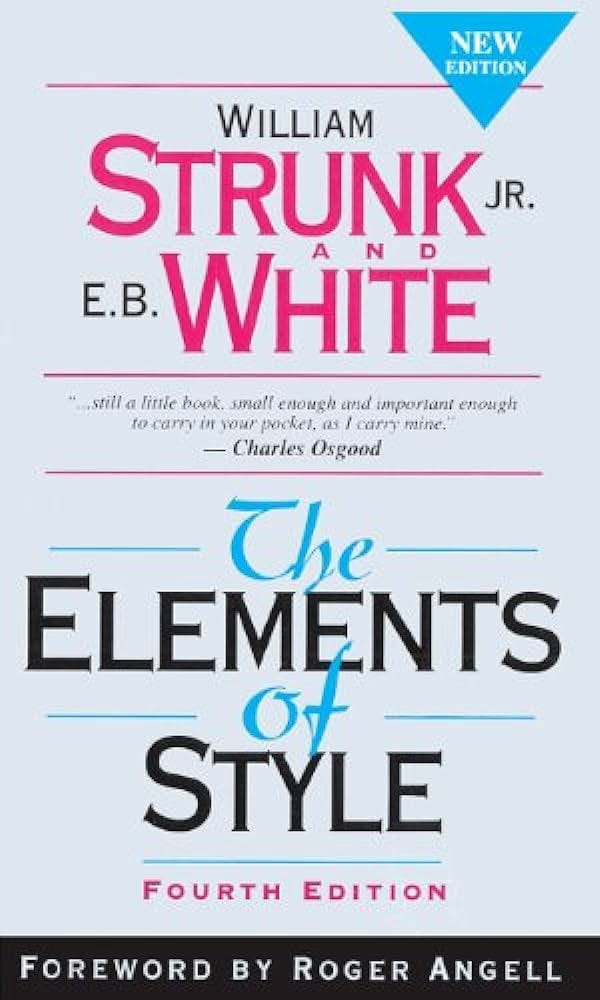
Of course I still carry that air of self-importance about me, so here I present to you “a few matters of form” or instead perhaps a set of “elementary rules of usage" that I call The Elements of Movement:
THE ELEMENTS OF MOVEMENT
The Elements of Movement are movement characteristics that divide manipulable movement variables into three categories:
Position: the position of the body relative to itself and to space as it holds a shape and/or moves through space.
Motion: where and how the body or load moves through space.
Load: any external loading of the body through resistance like weights, pressure, or any increase in gravitational forces.
The Elements can be manipulated and combined to create a wide variety of training effects as well as adapting exercises for individual needs.
WAIT…WTF DOES THIS STUFF MEAN?
There’s a lot of moralizing in exercise: a perceived right and wrong way to perform movements; “safe” and “dangerous” movements; and “good” and “bad” bodies (aka acceptable within the current power structure and those existing outside the realm of acceptability since they don’t conform to the “desired” body [thin, white, cis, able-bodied*]).
*For more information on body politics I recommend searching out people much more qualified to speak on the subject such as Fitness For All Bodies, Sonya Renee Taylor, and the ASDAH (to name a few).
It’s all, well, wrong. Movements are movements: neither safe nor dangerous, good nor bad. They just are. Same with bodies: neither good nor bad, but simply bodies existing in the world. Movements are tools and knowing how and why to use them makes the process a whole lot easier.
The Elements of Movement are a way that we can use a few basic shapes, positions, and paths of travel to fit exercises to our wants and needs without attaching some sort of moral significance to them.
INTENTION
Before diving in to using the Elements we have to figure out what we want out of our exercise. This want is called intention: for exercise to have a positive impact, it must have context. Meaningful activity has a significantly better outcomes for movers than arbitrary exercise. Intention is the goal, the reason for exercising, and the guiding light for all the subsequent decisions we make when choosing an exercise.
Want to get stronger?
More flexible?
Gain endurance?
These are might seem like obvious examples of intention, but they can be far more nuanced and/or specific. It doesn’t matter what your intention is, as long as it’s important to you.
Here’s how you can use the Elements to make a movement work better for you and your intention:
POSITION
Position refers to how the body is placed in space while doing an exercise. It is divided into two parts:
Angle: the relationship of the body to space and/or itself as it holds a shape or travels through a movement. This can be a static relationship (such as turning the foot out in a yoga pose) or a dynamic one (moving the elbow away from the side in a push-up). Usually we adjust angle to make a movement work better for a certain body type (ie, people with long limbs are going to move differently through space than people with short ones), or to elicit a different training effect (muscular recruitment, movement complexity, etc).
Base: Base refers to what part of the body is supporting the majority of the body weight, also known as the Base of Support (BoS). It can be the feet, hands, knees, elbows, hips, or any part of the body contacting the primary support surface (ie, the ground).The primary purpose of most exercise is to orient the Center of Mass (CoM) of the body over the BoS while performing a preset pattern like a squat, hinge, etc.
This orientation is something we do unconsciously throughout the day, standing, walking, even maintaining a sitting position requires us to hold our CoM aloft above our hips. Much like Angle, Base can be altered to fit morphology (the structure of the body), or intention.
Some of the ways Base can be altered are: points of contact (what and how many parts of the body contact the ground/supporting surface); width (the distance between supporting structures); and symmetry (the position of points of contact relative to each other—whether they are square or off-set).
MOTION
Motion is how the body moves through space, either as a cohesive unit, or part(s) moving relative to the rest of the body. Motion has 3 parts:
Range of Motion (ROM): how far a joint(s) moves through its available range. Joints are strongest in the middle ROM and drop off toward the end ranges. There’s no ideal ROM, but having more ROM accessible is generally a good thing, provided that you have some degree of control over it, though how far you travel through your ROM in any one exercise depends heavily on intention: want to get stronger? Train mostly in the middle range of a muscle or movement pattern. Want to gain flexibility? Train toward the end of your available ROM.
Direction: where the body moves through space relative to its starting position. Could be up and down, side to side, or even at an angle. There’s not a right direction, but it’s generally good to move in different directions (we call this “movement variety”). Most of the time people are strongest going in the up and down and forward and back directions, so use those if you’re interested in gaining the most possible strength.
Path: how the body—or part of it—moves itself and objects through space. The most efficient path of travel is in a straight line (look at the sport of powerlifting for an example of this), but much like direction, changing the path of travel in a movement adds variety and often challenge (though sometimes it might make something easier).
LOAD
Load refers to any additional physical stress placed upon the body. It can take the form of external loads like weights but also any type of gravitational resistance you might experience when moving your body through space such as in a push-up, pull-up, or other common bodyweight movement.
Load is usually measured in light to heavy: a spectrum of increasing weight, resistance, or complexity, most easily quantified through the adjustable incremental weights that are found in most gyms in the form of dumbbells, kettlebells, barbells, and machines. Load can be increased in bodyweight movements by increasing their complexity through moving or altering Elements like angle, base, and range of motion.
Adding load is a way to increase the amount of feedback you’re getting from a pattern or position, much like angle, direction, or any of the other Elements. This process is an essential part of exercise-based movement and getting stronger, and has the added bonus of being a clear, quantifiable way to measure progress.
There are a few ways to measure load:
External load: Additional weight or resistance, usually in the form of weights.
Mechanical disadvantage: Holding a weight or resisting a force in a less advantageous position (ie, at arms’ length).
External force: Any external pressure exerted on the body, such as pressing against a fixed object, another person pushing or pulling on your body, or even the force of gravity as you attempt to hold your body in a position like a plank, handstand, or squat.
Load placement is also a consideration when using any kind of resistance: usually the body is able to handle more load when it is close to the CoM (Center of Mass) and held in either both hands or the rack position (on the shoulders, either in front or behind). It can be held in numerous other ways, but those are easy places to start.
SO WHAT AM I SUPPOSED TO DO WITH ALL OF THESE?
Lucky for you I wrote a book on this. Three, actually:
Paradoxa was the first foray into this idea. You can get it digitally or in print on my website:
The second is called Arcane Exercise, and I don’t explicitly call this concept The Elements of Movement in it: instead, I contextualize this type of movement deconstruction through tabletop roleplaying game (ttprg) mechanics. It’s an easy way to break down movement and I like games, so why not?
Arcane Exercise is currently out of print*, but you can get a digital version of the second edition and all the expansions for the series on my itch.io page:
Arcane Exercise 2nd Edition and Supplements (digital format)
The third is an adaptation of Arcane Exercise called The Adventurer’s Guide to Exercise: it further explores the idea of using ttrpg mechanics to explain exercise. It’s a simplified version of the idea that uses common roleplaying games character classes (Fighter, Rogue, and Ranger) to characterize exercise programs. You can find that through my itch.io link above.
And if you’re tired of reading my stuff and just want an answer to the question “how do I use this stuff?” right now, here’s a free quick start guide to get you going:
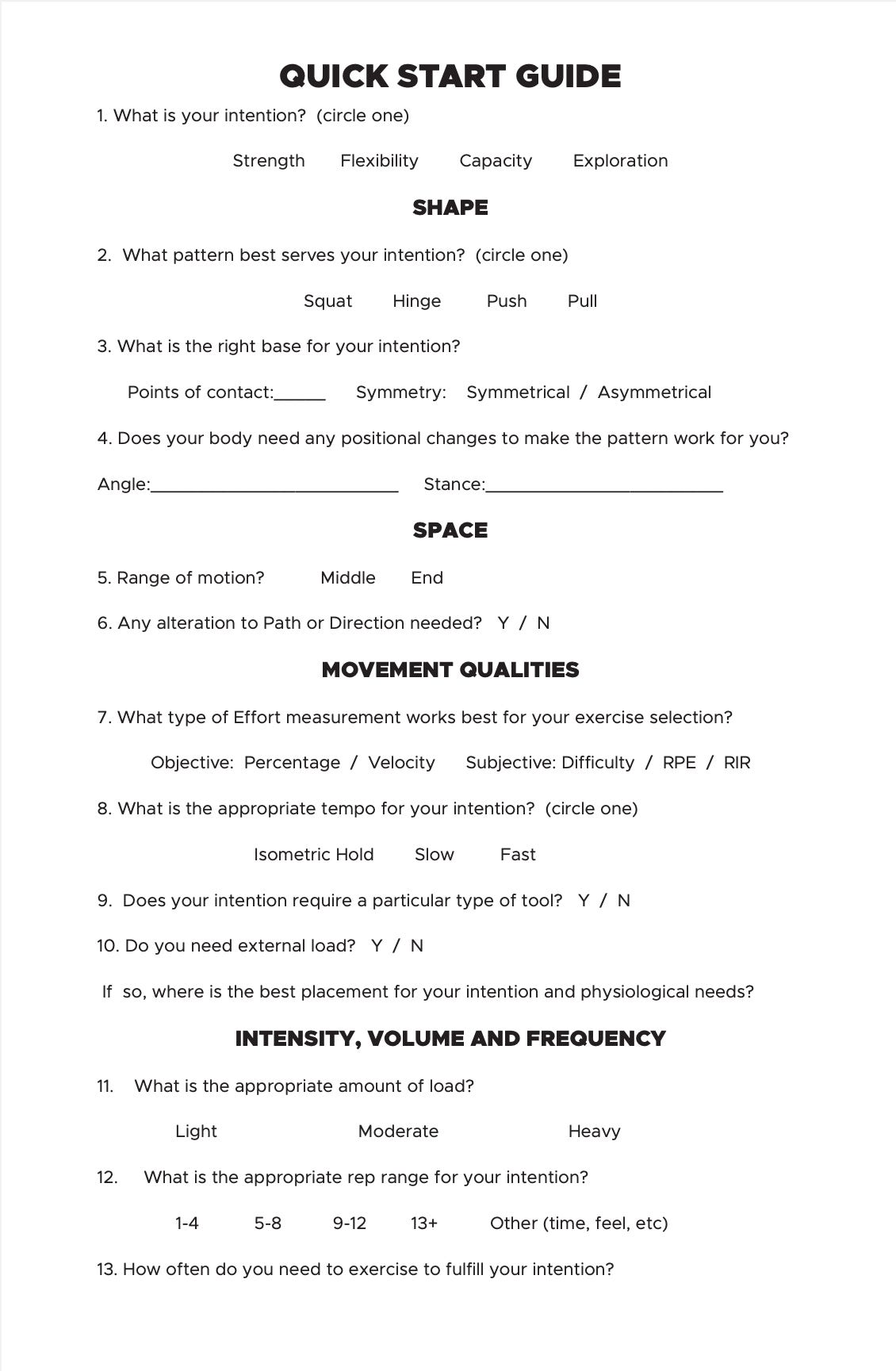
Beyond that, ask yourself the following questions when choosing a movement:
What do I want to get out of this? (Intention)
What can I do right now? (Individual needs)
How can I use the Elements adapt the movement to fit my Intention and Needs?
How can I progress the movement using the Elements to reach my goal(s)?