
Performative exercise
Are you showing off or showing up?

I’m rarely good at anything the first time I try it. Usually the first 100 times suck really bad, if not more. It took me hundreds of tries to get the trick shown below.
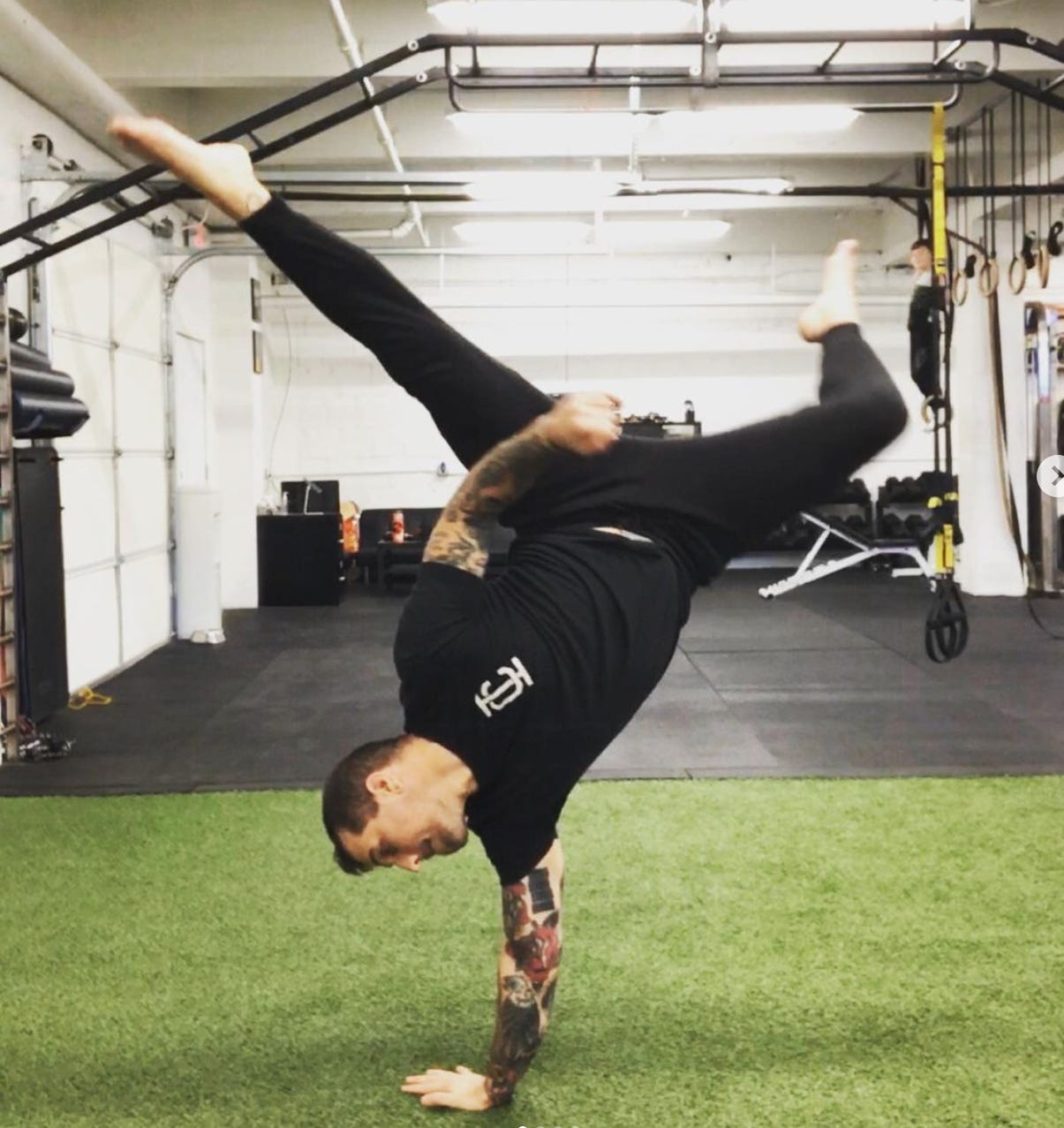
That doesn’t mean I think I’m “bad” at things. I don’t think it really means much at all, other than the fact that I try to do new things, which I think is probably a good thing.
I do a fair amount of training in the gym: working on specific drills to alter the function, position, or make-up of joints and muscles. That’s a pretty unscientific explanation of training, but it points out the difference between training and exercise versus what I would call tricks, feats, or stunts—stuff that is done for the purpose of doing it (usually to look cool).
The former (training) is largely boring, monotonous, and requires lots of focus. It’s not sexy. The name says it all: it’s the process of training (aka preparing) our bodies/minds/nervous systems for something. We can train for anything. It’s the process that leads to that anything, usually broken down into component parts.
Tricks are a result. The endpoint (or at least a benchmark) of the training process. They’re something you try once you’ve prepared sufficiently to understand and execute.
The problem arises when training becomes tricks: when what we do in the gym (or wherever we move our bodies) becomes performative, and we skip the training part because we want to do the cool thing. It’s much more attractive to do weird lifts, handstands, flips, etc than it is to do all the minutiae that leads up to those things.
There’s nothing wrong with wanting to do things that are cool and fun. But the true value is in the process. That’s where we gain the physical, emotional, and spiritual benefits. To skip all that and to expect to be able to perform is to miss the point entirely.
Try and fail. Fail and learn. Try again. Fail again. Repeat process ad nauseam. Review personal values and determine whether the process adds to your life. Maintain course or redirect. This process is a way we can use physical training not only to learn skills, but also to help us clarify who we are and what we want out of training and life.